360° Spine Care | Dr. Rohit Thaker | Best Spine Surgeon Ahmedabad
નાનકડું એન્ડોસ્કોપ, મોટી આરામદાયક સારવાર – દરેક સ્પાઇન સમસ્યાનો આધુનિક ઉપાય. Thoracic Spine Endoscopy | Minimally Invasive Spine Treatment by Dr. Rohit Thaker in Gujarat
Learn how thoracic spine problems can be treated safely with advanced endoscopic spine surgery. Dr. Rohit Thaker, Gujarat’s leading Minimally Invasive & Endoscopic Spine Specialist, offers faster recovery, minimal pain, and highly precise treatment for thoracic disc herniation and nerve compression.
Dr. Rohit Thaker
11/24/20253 min read
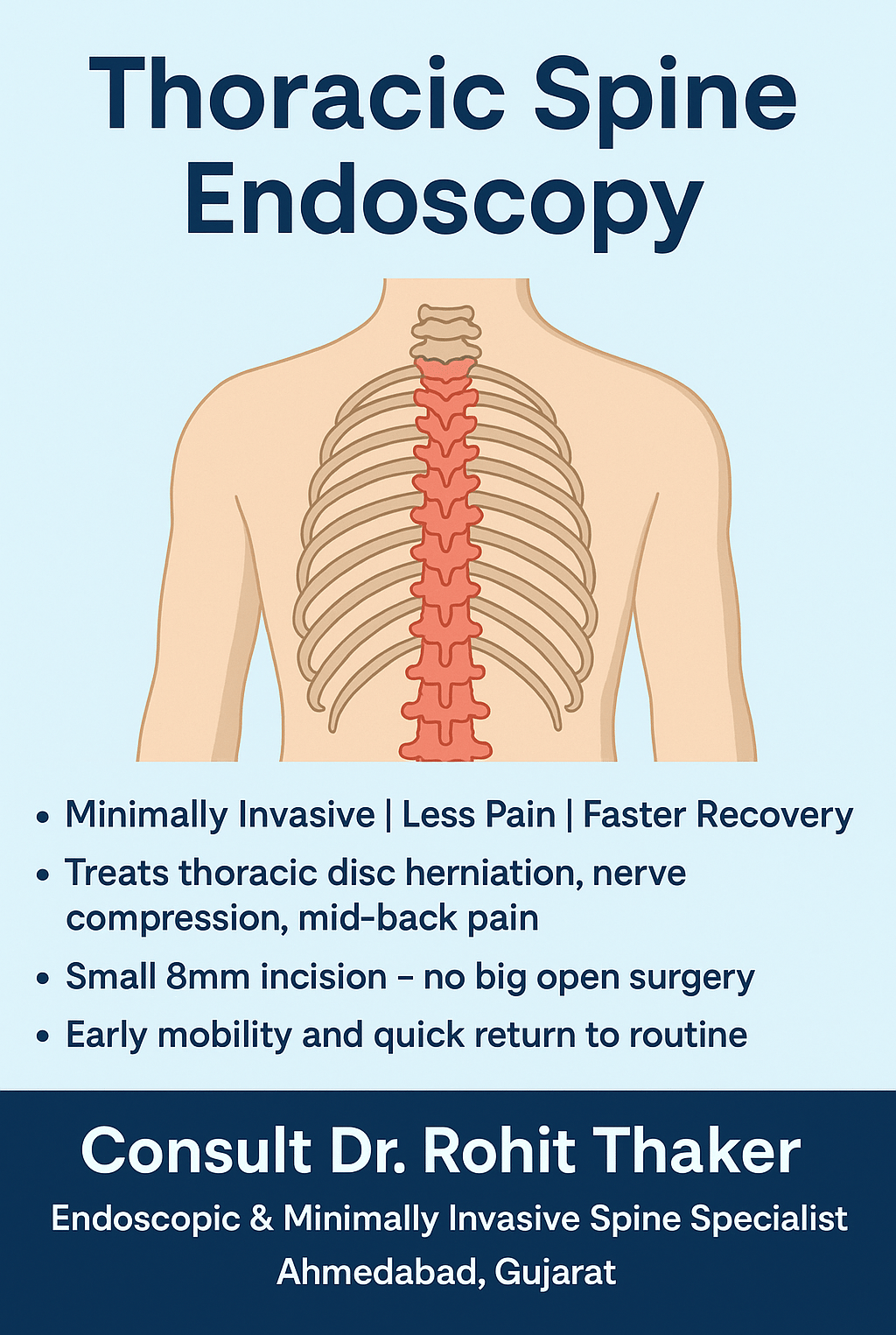
Thoracic Spine Endoscopy: A Modern, Minimally Invasive Solution for Mid-Back Problems
How Dr. Rohit Thaker is Advancing Thoracic Spine Care in Gujarat
Thoracic spine problems—pain in the mid-back region—are often misunderstood, under-diagnosed, and sometimes difficult to treat using traditional surgical methods. But with the rise of Spine Endoscopy, even complex thoracic spine issues can now be managed safely through tiny keyhole incisions, minimal tissue damage, and fast recovery.
Today, Thoracic Spine Endoscopy has become one of the most progressive treatment options for patients suffering from conditions like thoracic disc herniation, spinal canal narrowing, ligament hypertrophy, and certain cases of spinal compression.
In Gujarat, Dr. Rohit Thaker is among the very few spine specialists consistently performing these advanced endoscopic procedures with excellent patient outcomes.
⭐ What Is Thoracic Spine Endoscopy?
Thoracic Spine Endoscopy is a minimally invasive surgery performed using a small tubular system (8 mm–10 mm) and a high-definition camera.
This technique allows the surgeon to:
See the spinal nerves and disc clearly
Remove the problematic disc fragment or bone spur
Decompress the spinal cord with precision
Preserve most of the natural anatomy
Avoid large cuts or muscle removal
Even though the thoracic spine lies close to the lungs and ribs—making it traditionally difficult to operate—the endoscopic approach makes it safer and more precise.
⭐ When Is Thoracic Endoscopy Recommended?
Patients may benefit from endoscopic thoracic surgery if they have:
Thoracic Disc Herniation causing chest or rib pain
Myelopathy (weakness due to spinal cord compression)
Numbness or burning sensation around chest, abdomen, or back
Failed physiotherapy or injections
Radiating pain to rib cage or upper abdomen
Spinal stenosis at thoracic levels
If symptoms persist or neurological signs appear, early treatment helps avoid long-term nerve damage.
⭐ Benefits of Thoracic Spine Endoscopy
Compared to traditional open surgery, endoscopic spine surgery offers major advantages:
✔ Very Small Incision (8 mm)
Less pain, minimal blood loss, and faster healing.
✔ No Major Muscle Cutting
Preserves normal spine strength.
✔ Safest Approach Near the Spinal Cord
Endoscopic visualization provides magnified, crystal-clear detail.
✔ Reduced Hospital Stay
Most patients walk the same day or next morning.
✔ Faster Return to Routine Activities
Many can resume office work within a few days or weeks.
✔ Lower Infection and Scar Risk
Tiny stitch = tiny scar.
⭐ Why Thoracic Spine Problems Need a Specialist
Thoracic region surgery is more challenging because:
The spinal cord is narrow and sensitive in this area.
Traditional open surgery requires large exposure.
Misdiagnosis is common due to “radiating pain” that mimics rib or chest problems.
This is why thoracic endoscopy requires a surgeon with deep expertise in minimally invasive and endoscopic spine surgery.
⭐ How Dr. Rohit Thaker Performs Thoracic Endoscopic Surgery
Dr. Rohit Thaker, Spine Specialist & Endoscopic Spine Surgeon in Gujarat, has been using advanced techniques to treat even complex thoracic spine conditions with minimal surgery.
His approach includes:
🔹 1. HD Endoscopic Visualization
Provides clear magnification of nerves, discs, and bone—ensuring precise decompression.
🔹 2. Special Endoscopic Instruments
Allows safe handling of delicate thoracic spinal cord and nerve root structures.
🔹 3. Navigation & Neuromonitoring (When Required)
Enhances accuracy and safety in tricky thoracic levels.
🔹 4. Targeted Decompression Only
Removes only the damaged fragment, preserving natural stability and strength.
🔹 5. Ultra-Minimally Invasive Technique
No large cuts, no rib removal, no muscle stripping.
🔹 6. Fast Recovery Philosophy
Patients are encouraged to mobilize early with minimal post-operative discomfort.
⭐ Who Is an Ideal Candidate for Thoracic Endoscopy?
You may be suitable for endoscopic thoracic surgery if:
MRI shows thoracic disc compression
You have persistent mid-back pain
Numbness or tingling around ribs/abdomen
Difficulty walking due to spinal compression
Pain not improved with medications or physiotherapy
A detailed consultation and MRI evaluation help decide the best treatment approach.
⭐ Recovery After Thoracic Spine Endoscopy
Most patients experience:
Immediate relief in nerve compression symptoms
Walking within 24 hours
Return to home in 1–2 days
Return to work in 1–3 weeks (depending on job nature)
Regular physiotherapy and posture correction help optimize long-term outcomes.
⭐ Why Patients Choose Dr. Rohit Thaker in Gujarat
Patients across Gujarat prefer consulting Dr. Thaker due to:
Specialized training in Spine Endoscopy & Minimally Invasive Spine Surgery
Experience in handling complex thoracic cases
Patient-centric approach with detailed explanations
Modern infrastructure, navigation systems & latest endoscopic technology
A philosophy focused on small incisions and big results
His expertise makes thoracic spine endoscopy a safe and reliable option for patients who earlier feared large surgeries.
⭐ Conclusion
Thoracic Spine Endoscopy is a breakthrough minimally invasive technique that allows precise and safe treatment of mid-back spine problems—without the need for big or scary operations.
With advanced endoscopic methods, patients can enjoy:
Less pain
Minimal hospital stay
Faster recovery
Safer outcomes
If you are experiencing persistent thoracic back pain, rib pain, or nerve symptoms, consulting an endoscopic spine specialist like Dr. Rohit Thaker in Gujarat may be the first step toward lasting relief.