Can Spinal Stenosis Cause Difficulty Walking?
You used to walk without thinking about it. Now, after a few hundred meters, your legs feel heavy, numb, or strangely weak, and you find yourself stopping more often than you should. Sitting down brings relief, but the moment you start walking again, the same feeling returns. If this pattern sounds familiar, you are not alone and you are not imagining it. What you are describing is one of the most classic presentations of spinal stenosis, a condition that affects thousands of patients across India, many of whom spend months or years attributing it to “old age” or “tiredness” before getting a proper diagnosis.
For patients in Ahmedabad experiencing these symptoms, understanding what is happening in your spine and exploring Spinal Stenosis Treatment in Ahmedabad is the first step toward getting your mobility back.
Why Does Spinal Stenosis Make Walking Difficult?
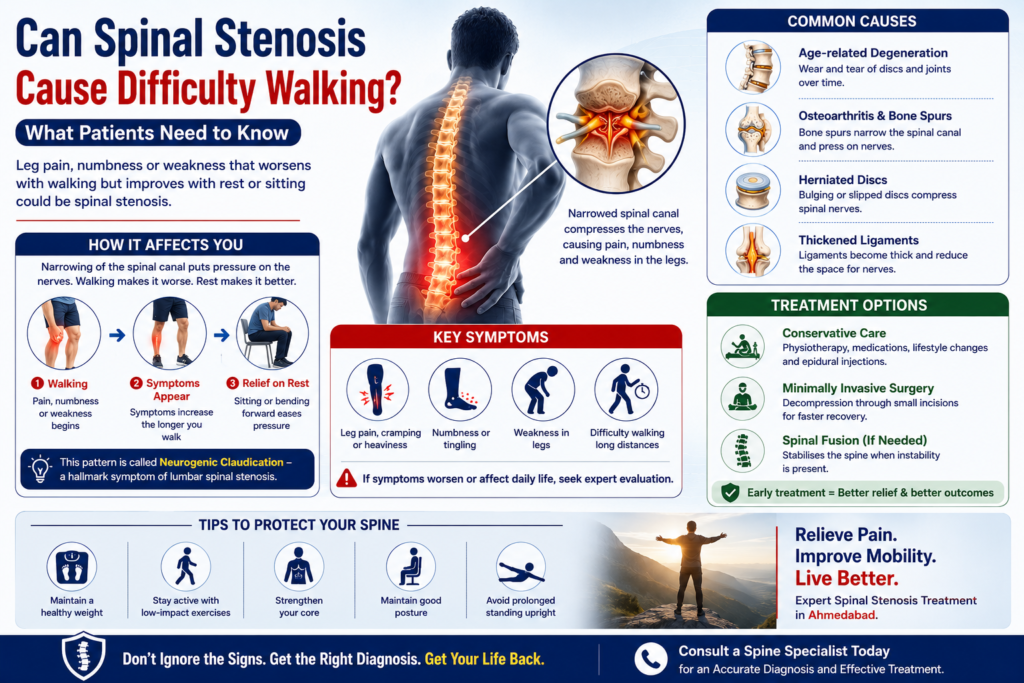
This is the question patients most often ask, and the answer explains a lot. When you stand upright and walk, your lumbar spine naturally extends (arches slightly backward). This position reduces the already-narrowed space in the spinal canal even further, increasing pressure on the compressed nerves. The nerves, deprived of adequate blood flow and space, begin to send distress signals experienced as pain, numbness, heaviness, or weakness in the legs.
When you sit down or lean forward like gripping a shopping trolley or sitting on a bench the lumbar spine flexes, opening up the spinal canal slightly. The pressure eases, the nerves recover, and the symptoms subside. This specific pattern of leg symptoms that worsen with walking and improve with sitting or bending forward has a clinical name: neurogenic claudication. It is the hallmark symptom of lumbar spinal stenosis, and recognising it is the key to getting the right diagnosis.
Causes of Spinal Stenosis
Spinal stenosis is usually a gradual process. The most common causes include:
- Age-related degeneration the most frequent cause; discs lose height, joints enlarge, and ligaments thicken over decades, collectively narrowing the canal
- Osteoarthritis bony spurs (osteophytes) grow inward from the vertebrae and facet joints, encroaching on nerve space
- Herniated discs disc material bulging into the canal compresses the nerves directly
- Thickened ligamentum flavum the ligament running along the back of the spinal canal can buckle and thicken with age, reducing canal space significantly
- Spondylolisthesis one vertebra slipping forward over another, distorting the canal
- Congenital narrowing some patients are born with a naturally narrower spinal canal, making them more susceptible to symptomatic stenosis earlier in life
Symptoms Beyond Walking Difficulty
While difficulty walking is often the most disruptive symptom, spinal stenosis produces a wider range of complaints:
- Lower back pain often a dull ache, sometimes radiating into the buttocks
- Leg pain, cramping, or burning typically in both legs, though one side may be worse
- Numbness and tingling in the feet, calves, or thighs
- Leg weakness a feeling of the legs “giving out” or unreliability when walking
- Reduced walking distance over time patients find they can walk shorter and shorter distances before needing to rest
- Bladder or bowel changes in more severe cases, nerve compression can affect continence; this requires prompt evaluation
Risk Factors
- Age above 50 stenosis becomes significantly more common with age
- History of back problems, prior disc herniations, or spinal surgery
- Osteoarthritis affecting the spine
- Obesity increases load on the lumbar spine, accelerating degeneration
- Physically demanding occupations involving repeated bending or lifting
Treatment Options for Spinal Stenosis
Conservative Management
Many patients with mild to moderate stenosis improve significantly with non-surgical treatment:
- Physiotherapy targeted exercises to strengthen core and back muscles, improve posture, and reduce load on the lumbar spine
- Pain management anti-inflammatory medications, nerve pain modulators, and muscle relaxants used appropriately
- Epidural steroid injections corticosteroid injected around the compressed nerve reduces inflammation and provides meaningful pain relief, sometimes for several months
- Activity modification understanding which postures and activities aggravate symptoms, and adjusting daily habits accordingly
Minimally Invasive Surgical Options
When conservative treatment fails to provide adequate relief, or when neurological symptoms are worsening, surgery becomes the right next step. The goal is decompression, creating more space for the compressed nerves.
Modern surgical options include the following:
- Laminectomy removing part of the vertebral arch to widen the spinal canal; the most common surgical procedure for stenosis
- Laminotomy or laminoplasty, more limited procedures preserving more of the vertebral structure
- Spinal fusion performed alongside decompression when instability or spondylolisthesis is present, to stabilise the spine
Many of these procedures can now be performed using minimally invasive techniques, offering smaller incisions, less muscle disruption, reduced blood loss, and faster recovery compared to traditional open surgery.
Benefits of Early Treatment
Choosing to address spinal stenosis before it becomes severely limiting carries real advantages:
- More treatment options remain available including less invasive approaches
- Nerves that have been compressed for shorter periods tend to recover more fully
- Quality of life is preserved avoiding years of restricted mobility and dependence on others
- Surgical outcomes are generally better in patients who have not developed significant muscle weakness or severe neurological deficit from prolonged compression
Recovery Tips After Spinal Stenosis Surgery
- Begin gentle walking as early as your surgeon advises movement is a critical part of nerve recovery
- Commit to physiotherapy post-operative rehabilitation is not optional; it determines how fully you regain strength and mobility
- Avoid bending, twisting, and heavy lifting during the initial recovery period
- Sleep with a pillow between your knees if side-sleeping, to maintain spinal alignment
- Attend all follow-up appointments nerve recovery is gradual and needs monitoring
Prevention and Lifestyle Tips
While age-related degeneration cannot be fully prevented, these habits slow the process and reduce symptoms:
- Maintain a healthy body weight to reduce spinal load
- Stay physically active with low-impact exercise swimming, cycling, and walking (within your current tolerance) all support spinal health
- Strengthen your core a strong core reduces the load on lumbar structures
- Practice good posture, especially during prolonged sitting
- Avoid prolonged standing in an upright position if it reliably triggers your symptoms
Final Thoughts
Difficulty walking is not something you have to accept as an inevitable part of ageing or back pain. When it follows the specific pattern of worsening with walking and easing with rest or leaning forward, it points toward a treatable condition and one that responds very well to the right management.
Whether you need physiotherapy, injections, or surgical decompression, the path forward starts with an accurate diagnosis. Patients in Ahmedabad seeking expert evaluation for leg pain, walking difficulty, or back-related nerve symptoms can access world-class care locally through Spinal Stenosis Treatment in Ahmedabad. Dr. Rohit Thaker, a specialist spine surgeon in Ahmedabad, provides comprehensive assessment and personalized treatment for spinal stenosis from conservative care through minimally invasive surgery with a focus on restoring your mobility and your independence.