Endoscopic Spine Surgery: Is It Better Than Traditional Open Spine Surgery?
“Do I really need open surgery?” It’s one of the most common questions spine specialists hear and it’s a fair one. The idea of a large incision, general anesthesia, weeks of bed rest, and months of recovery is enough to make anyone anxious. The good news is that for many spine conditions, there’s a better path.
Microendoscopic minimally invasive spine surgery has changed the way spine conditions are treated. Patients who once faced long hospital stays and painful recoveries are now going home the same day or the next, returning to daily life far sooner than they expected. But is it right for everyone? And how does it actually compare to traditional open surgery?
If you’re weighing your options or trying to understand what your doctor has recommended, this article breaks it all down clearly and honestly.
What is Traditional Open Spine Surgery?
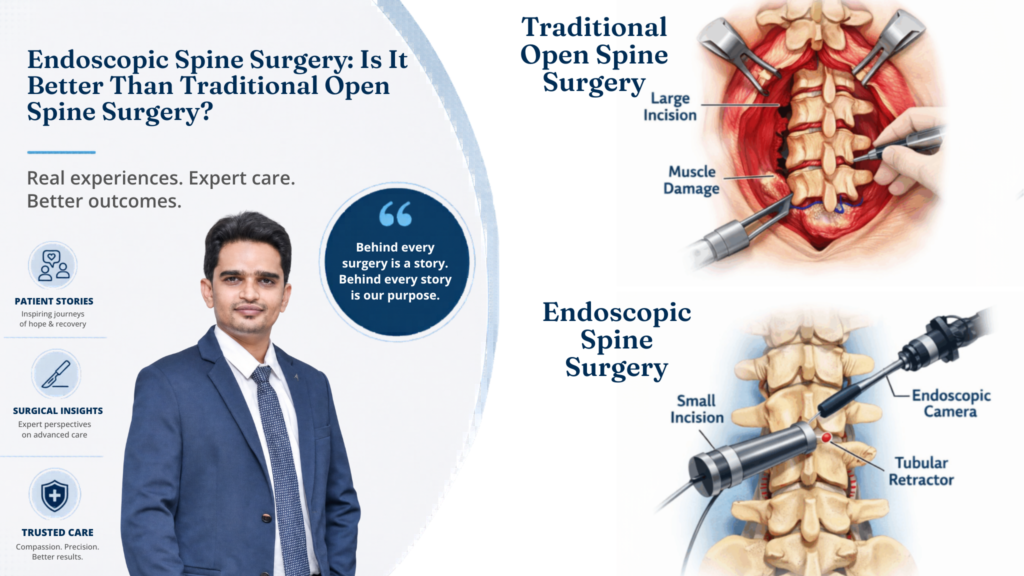
To appreciate modern medical advances, it helps to look at how things used to be done. In a traditional open spine surgery, the surgeon makes a relatively large incision down the center of the back. To clearly see the problem area, such as a herniated disc pinching a nerve, the surgeon must detach and pull aside the large muscles supporting your spine.
While this method gives the surgeon a direct line of sight, pulling and separating these muscles can cause significant tissue irritation. This muscle trauma is often the primary reason for post-operative pain and a lengthy recovery period.
What Is Endoscopic Spine Surgery?
Endoscopic spine surgery is a minimally invasive technique where the surgeon operates through a very small incision, often less than a centimeter, using a thin tube called an endoscope. This tube carries a tiny camera and light source, projecting a magnified, high-definition view of the spine onto a monitor.
The surgeon guides specially designed instruments through this tube to address the problem, whether that’s removing a herniated disc, decompressing a nerve, or treating spinal stenosis (narrowing of the spinal canal) without disturbing the surrounding muscles and tissues.
Compare that to traditional open surgery, where the surgeon makes a long incision and manually moves muscles aside to access the spine. Both approaches can treat the same conditions. The difference lies in how the body is treated along the way.
Traditional Open Spine Surgery: What It Involves
Open spine surgery has been the standard for decades. It’s well-studied, effective, and in certain complex cases, still the most appropriate choice. Here’s what a typical open procedure involves:
- A long incision (sometimes several inches) over the affected area of the spine
- Significant muscle retraction: muscles are pulled aside and held open throughout the operation
- Extended operating time and longer time under general anesthesia
- Hospital stay of 3–5 days or more
- A recovery period that can range from 6 weeks to several months
- Higher risk of blood loss, infection, and post-surgical muscle weakness
None of this is said to alarm you. Open surgery saves lives and restores function. But when a less invasive option can achieve the same surgical goal with significantly less trauma to the body, it deserves serious consideration.
How Microendoscopic Surgery Works Differently
The core principle of micro endoscopic surgery is simple: do what needs to be done, but disturb as little healthy tissue as possible.
Smaller Incision, Bigger Difference
The incision in endoscopic spine surgery is typically 7–10 mm, about the width of a pencil eraser. This alone dramatically reduces trauma to the surrounding tissues.
Muscle-Sparing Technique
In open surgery, the muscles alongside the spine are stripped and retracted, which is a significant source of post-operative pain and prolonged recovery. Endoscopic techniques work between muscle fibers or through natural tissue planes, preserving their integrity.
Real-Time Visualization
The endoscope provides a magnified, illuminated view that’s actually superior in some ways to what’s visible with the naked eye in open surgery. Surgeons can see fine structures clearly, which supports more precise, targeted treatment.
Performed Under Local or General Anesthesia
Many endoscopic procedures can be performed under local or spinal anesthesia, which is safer for patients with certain health conditions and reduces post-operative grogginess and nausea.
Conditions Treated With Endoscopic Spine Surgery
Micro endoscopic minimally invasive spine surgery is not just for simple cases. It is now routinely used to treat:
- Lumbar disc prolapse– A slipped or bulging disc pressing on a nerve root
- Spinal stenosis-Narrowing of the spinal canal causing leg pain, numbness, and weakness
- Foraminal stenosis -Compression of a nerve as it exits the spine
- Degenerative disc disease-Wear and tear of the spinal discs causing chronic pain
- Spondylolisthesis-A condition where one vertebra slips over another
- Cervical disc problems-Neck disc issues causing arm pain or weakness
The technique has evolved significantly over the past decade. Conditions that previously required open surgery are now routinely handled endoscopically by experienced spine surgeons.
The Real Benefits Patients Notice
Patients who undergo micro endoscopic minimally invasive spine surgery often report outcomes that surprise them in the best way:
- Less pain after surgery.Because the muscles are largely preserved, post-operative pain is significantly reduced. Many patients need far less pain medication.
- Faster mobility.Most patients are walking within hours of surgery.
- Shorter hospital stay.Daycare or overnight procedures are common.
- Quicker return to work.Desk job patients often return within 1–2 weeks. Those with physical jobs may need 4–6 weeks.
- Smaller scar.The tiny incision heals quickly and leaves minimal scarring.
- Lower infection risk.Smaller wounds mean less exposure, which reduces the risk of post-surgical infection.
- Preserved future options.Because surrounding tissue is left intact, future surgeries (if ever needed) are not complicated by prior muscle damage.
Who Is the Right Candidate?
Not everyone is automatically a candidate for endoscopic surgery. Your suitability depends on:
- The specific diagnosis and severity of the spinal condition
- Your general health and medical history
- Whether you’ve already tried non-surgical treatments like physiotherapy and injections
- The number of spinal levels involved
- Previous spine surgeries
A thorough evaluation, including MRI, physical examination, and a detailed review of your history, helps the surgeon determine the safest and most effective approach for you.
Recovery After Microendoscopic Spine Surgery
Recovery is genuinely one of the strongest arguments for the endoscopic approach. Here’s what to expect:
- Day 1:Most patients walk the same day. Mild discomfort is normal and manageable.
- Week 1–2:Light activities resume. Short walks are encouraged. Avoid prolonged sitting, bending, and lifting.
- Week 2–4:Physiotherapy begins gentle core strengthening and posture correction.
- Week 4–8:Gradual return to normal work and activities depending on profession.
- 3 months onwards:Most patients are back to full activity, including exercise.
The key to a smooth recovery is following your surgeon’s guidance, not rushing back, and staying consistent with physiotherapy. The surgery does the structural work, rehabilitation builds lasting strength.
Practical Tips Before and After Surgery
Before surgery:
- Stop smoking, it impairs healing and increases surgical risk
- Maintain a healthy weight where possible, as excess weight stresses the spine
- Ask your surgeon every question you have, there are no silly questions
- Arrange transport and light home support for the first few days
After surgery:
- Sleep on your back or side with a pillow under your knees for comfort
- Avoid twisting or bending at the waist in the early weeks
- Stay hydrated and eat a nutritious diet to support tissue healing
- Report any fever, increased pain, swelling, or wound changes to your doctor immediately
Moving Forward with Confidence and Clarity
Living with chronic spine pain can make your world feel incredibly small, turning simple daily tasks into major physical challenges. It is completely normal to feel hesitant about spine surgery, but understanding that modern medical technology allows us to protect your body while fixing the underlying issue can help replace fear with hope.
Every spine is unique, and the right treatment plan depends entirely on your specific symptoms, lifestyle, and diagnostic scans. If you are ready to explore your options and find out if you qualify for a Micro Endoscopic Minimally Invasive Spine Surgery, taking the step to consult a trusted professional like Dr. Rohit Thaker can give you a clear, personalized roadmap back to a comfortable, active, and pain-free life. Contact a specialist today to begin your recovery journey.