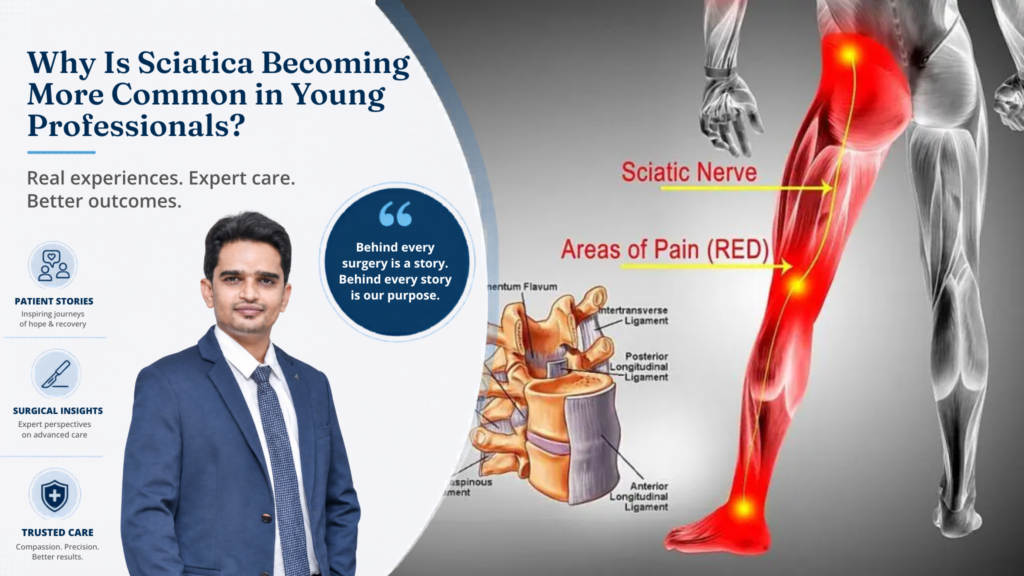
Why Is Sciatica Becoming More Common in Young Professionals?
And What You Can Do About It Before It Gets Worse
You’re 28 years old. You work a desk job and spend eight to ten hours sitting in front of a screen, and lately you’ve been feeling this sharp, shooting pain running from your lower back down through your leg. You brush it off as muscle fatigue. But it keeps coming back, and it’s getting harder to ignore.
If this sounds familiar, you’re not alone. Sciatica, once considered a condition that mostly affected people in their 40s and 50s, is now showing up in young professionals at an alarming rate. Doctors across the country are seeing more patients in their 20s and 30s walking in with classic sciatica symptoms, and the reasons are deeply tied to how we live and work today.
If you’re dealing with this kind of pain and looking for effective sciatica treatment in Ahmedabad, understanding what’s happening inside your body is the first step toward real relief.
Sciatica: What Is Actually Happening?
To understand why your leg is hurting, it helps to look at the anatomy of your lower back. The sciatic nerve is the longest and thickest nerve in your human body. It originates in your lower back, runs through your hips and buttocks, and branches down each leg.
Sciatica isn’t a disease on its own. Instead, it is a medical symptom indicating that something is compressing, pinching, or irritating this major nerve. When that pressure occurs, it acts like a kink in a garden hose, disrupting the nerve signals and sending pain signals down the entire pathway.
Why Is Sciatica Hitting Young Professionals Harder Now?
There’s no single reason sciatica is rising among younger adults, but the pattern is clear. Here’s what’s driving it:
1. Prolonged Sitting Is the New Smoking
Remote work, long office hours, and back-to-back meetings have created a generation of people who sit for 8–12 hours a day. When you sit for that long, especially with poor posture, the lumbar discs in your lower back take on enormous pressure. Over time, this causes disc wear that can irritate the sciatic nerve
2. Weak Core Muscles
Most young professionals don’t realize that a weak core puts enormous strain on the spine. When the muscles around your abdomen and lower back aren’t strong enough to support your posture, the spine compensates in ways it shouldn’t. This is one of the most underappreciated causes of sciatica in otherwise healthy young adults.
3. Too Much Screen Time, Too Little Movement
Spending long hours on laptops and phones encourages a forward-head posture and rounded shoulders. This cascades down the spine, affecting the lumbar region. Many people also hold tension in their hip flexors and piriformis muscles and a tight piriformis can directly compress the sciatic nerve.
4. Stress and Poor Sleep
Chronic stress causes muscle tension. Poor sleep prevents proper muscle recovery. Both of these, over time, contribute to conditions that make the spine more vulnerable to injury and nerve compression.
5. Sudden High-Intensity Workouts Without Conditioning
Trying to compensate for a sedentary week with an intense weekend workout is a recipe for trouble. Lifting heavy weights with improper form or sudden impact activities can trigger disc herniation, one of the most common direct causes of sciatica.
Symptoms You Should Not Ignore
Not all back pain is sciatica. But here are the specific signs that should prompt you to seek medical attention:
- A sharp or burning pain starting in the lower back or buttock, running down one leg
- Numbness or tingling sensation in the leg or foot
- Weakness in the affected leg
- Pain that worsens when sitting for long periods
- Difficulty standing up after sitting
- A constant, aching discomfort on one side of the lower body
If you’re experiencing any of these, especially the combination of lower back pain with leg symptoms, please don’t wait it out.
Non-Surgical Treatment Options for Sciatica
The good news is that the vast majority of young adults suffering from sciatica do not need surgery. With early intervention and a structured recovery plan, the spine can heal remarkably well.
Targeted Physical Therapy
A specialized physical therapist can teach you specific exercises designed to take pressure off the sciatic nerve. This usually involves:
- Core stabilization exercisesto build a natural “muscular corset” around your spine.
- McKenzie method exercisesto help center a bulging disc back into its proper position.
- Hamstring and piriformis stretchesto reduce localized muscle tightness.
Short-Term Medications
To manage intense pain flare-ups so you can move and participate in physical therapy, your doctor might recommend short courses of anti-inflammatory medications, muscle relaxants, or nerve-pain modulators.
Advanced Pain Management
If physical therapy alone isn’t providing relief, conservative interventions like epidural steroid injections can be highly effective. This procedure delivers targeted anti-inflammatory medication directly around the irritated nerve root, drastically reducing swelling and calming severe pain.
When Surgery Becomes Necessary
Surgery is considered only when conservative treatments have not worked for 6–12 weeks or when the patient has severe neurological symptoms like progressive leg weakness or loss of bladder/bowel control.
The most common procedure is a microdiscectomy, removing the portion of a herniated disc pressing on the nerve. Recovery is typically faster than most people expect.
Recovery Tips That Actually Help
Whether you’ve just started treatment or are recovering from a procedure, here’s what will make a real difference:
- Stay active within your limits.Bed rest beyond 1–2 days usually makes sciatica worse, not better.
- Work on your posture.Invest in an ergonomic chair. Keep your screen at eye level. Take standing breaks every 45 minutes.
- Stretch daily.The piriformis stretch, knee-to-chest stretch, and seated spinal twist are particularly helpful.
- Strengthen your core gradually.Pelvic tilts, bridges, and bird-dog exercises are gentle yet effective starting points.
- Apply heat before activity, ice after.This helps loosen muscles before movement and reduce inflammation afterward.
- Follow your physiotherapy plan.Missing sessions is the single biggest reason sciatica returns.
How to Prevent Sciatica From Coming Back
Prevention isn’t complicated, but it does require consistency:
- Set a timer to stand and walk for 2–3 minutes every hour
- Strengthen your core at least 3 times a week
- Avoid sitting with your wallet in your back pocket (it tilts your pelvis)
- Sleep on your side with a pillow between your knees
- Lift objects by bending at the knees, not the waist
- Choose supportive footwear, especially if you’re on your feet a lot
- Manage stress with regular physical activity, proper sleep, and mindfulness
Small, consistent habits matter far more than occasional bursts of effort.
Closing Thoughts
Sciatica is no longer something you have to “age into.” Young professionals are dealing with it right now because of how we sit, how we work, and how we move (or don’t). The pain is real, and so is the solution. The most important thing to understand is that sciatica is treatable. With the right diagnosis and the right care, most people recover fully and go back to everything they love doing. Ignoring the pain, however, rarely makes it better.
If you’re in Ahmedabad and have been putting off that consultation, consider this your nudge. Dr. Rohit Thaker is available to help you understand exactly what’s causing your pain and chart the most effective path forward without unnecessary procedures and with your recovery as the priority.
Your back carries you through life. It deserves the same attention you give everything else.