
Could My Headaches Be Coming From My Neck?
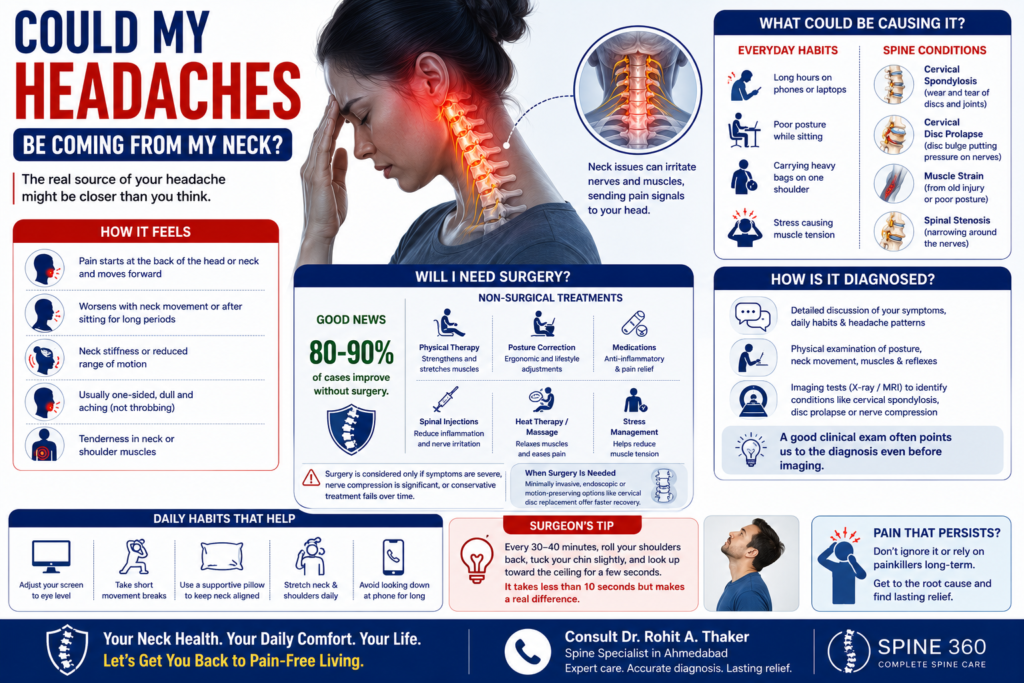
You’ve tried the usual fixes. Drinking more water. Cutting back on screen time. Even a stronger cup of coffee when things get bad. But that dull ache at the base of your skull keeps coming back, sometimes creeping up toward your temples by the end of the day. If painkillers only help for a few hours, it might be worth asking a different question: is this headache actually starting in your neck?
Dr. Rohit A. Thaker, as a spine specialist in Ahmedabad, sees this pattern more often than most patients expect. The neck and head are connected by a dense network of nerves and muscles, so when something in your neck isn’t quite right, your head often pays the price. Let’s walk through why this happens and what you can do about it.
Why Would a Neck Problem Cause a Headache?
Think of your neck as the foundation that supports a bowling ball, your head, all day long. When that foundation is out of alignment or under strain, the muscles around it tighten up to compensate. Those tight muscles, along with irritated nerves near the base of your skull, can send pain signals upward. This is often called a cervicogenic headache, which simply means a headache that originates in the neck rather than the head itself.
It’s a bit like a pinched garden hose. The blockage isn’t at the sprinkler, it’s further back at the source. Treating the head alone rarely fixes the real issue, and in some patients, the underlying driver turns out to be a spinal condition like cervical spondylosis, which is simply wear and tear of the neck’s discs and joints over time.
What Does This Type of Headache Usually Feel Like?
Not every headache is neck-related, so it helps to know the difference. Neck-related headaches often show up with a few telltale patterns:
- Pain that starts at the back of the head or neck and moves forward
- Discomfort that worsens with certain neck movements or after sitting for long periods
- Stiffness or reduced range of motion in the neck
- Pain that’s usually one-sided rather than affecting the entire head
- A dull, aching quality rather than sharp or throbbing pain
- Tenderness when pressing on the neck or shoulder muscles
If this list sounds familiar, your neck may genuinely be the source.
What's Actually Causing the Strain?
There isn’t just one culprit here. A few common causes tend to show up again and again in daily life, especially in a city like Ahmedabad where long commutes and desk-heavy jobs are the norm.
Everyday Habits That Add Up
- Hours spent looking down at phones or laptops
- Poor posture while sitting at a desk
- Sleeping in an awkward position or using the wrong pillow
- Carrying heavy bags on one shoulder
- Stress, which causes muscles to tighten without you even noticing
Underlying Spine Conditions
- Cervical spondylosis, the age-related wear and tear mentioned earlier
- Cervical disc prolapse, where a disc in the neck bulges and puts pressure on nearby nerves
- Muscle strain from an old injury that never fully healed
- In rare cases, spinal stenosis in the upper spine, which is a narrowing of the space around the nerves
Most cases fall into the first category. But when symptoms are persistent or severe, an underlying spine condition is worth ruling out.
Will I Need Surgery?
This is usually the first question patients ask, and understandably so. The reassuring answer is that around 80 to 90 percent of spine-related problems, including most neck-related headaches, are managed without surgery.
In the vast majority of cases, treatment starts with simple, non-surgical approaches:
- Physical therapy to strengthen and stretch neck muscles
- Posture correction and ergonomic adjustments
- Short-term use of anti-inflammatory medication
- Image-guided spinal injections for more stubborn pain
- Heat therapy or gentle massage
- Stress management techniques
Surgery becomes a consideration only in specific situations, such as significant nerve compression from a cervical disc prolapse, or symptoms that haven’t improved despite months of proper conservative treatment. Even then, options like minimally invasive spine surgery and endoscopic spine surgery mean smaller incisions, less muscle damage, and noticeably quicker recovery than the open surgeries of years past. In select cases, a motion-preserving option like cervical disc replacement can also be considered instead of fusion.
How Is the Cause Actually Diagnosed?
You don’t need to guess what’s causing your headaches. At my practice, Spine 360, a proper evaluation usually involves:
- A detailed conversation about when your headaches occur and what makes them better or worse
- A physical examination of your neck’s movement, posture, muscle tenderness, and reflexes
- Imaging tests like an X-ray or MRI, if a structural issue such as cervical spondylosis or disc prolapse is suspected
In fact, a good clinical exam alone often points us toward the diagnosis before we even look at a scan. This step-by-step process helps confirm whether your neck is truly the source, rather than something else entirely.
A Note from the Surgeon
Here’s something I tell almost every patient dealing with this issue: your headache probably started long before you noticed it. It builds up slowly, one long day at a desk at a time.
One simple habit change I recommend to nearly everyone is this. Every 30 to 40 minutes, pause and gently roll your shoulders back, tuck your chin slightly, and look up toward the ceiling for a few seconds. This tiny reset counters the forward head posture that builds up during screen time, and it takes less than 10 seconds. Patients who do this consistently, even without any other treatment, often notice a real difference within a couple of weeks.
Small, repeated habits tend to matter more than occasional big efforts when it comes to neck health.
Recovery and Prevention Tips
Whether you’re managing symptoms on your own or recovering from treatment, these habits genuinely help:
- Adjust your desk setup so your screen sits at eye level
- Take short movement breaks throughout the day
- Use a supportive pillow that keeps your neck aligned while sleeping
- Stretch your neck and shoulders gently each morning
- Stay mindful of your posture while using your phone
None of these changes need to be dramatic. Consistency matters far more than intensity.
Final Thoughts
Headaches that trace back to the neck are more common than most people realize, and the good news is that they’re also highly manageable once properly diagnosed. You don’t have to keep cycling through painkillers hoping the next dose works better.
If your headaches have been lingering longer than they should, consider scheduling a consultation at Spine 360 with Dr. Rohit Thaker to get a clear picture of what’s really going on and find a path toward lasting relief.